| Optical communication |
|


|
|
|
| Revisiting the nonlinear Gaussian noise model for hybrid fiber spans |
Ioannis Roudas*( ),Jaroslaw Kwapisz(),Xin Jiang() ),Jaroslaw Kwapisz(),Xin Jiang() |
Department of Electrical and Computer Engineering, Montana State University, Bozeman, MT 59717, USA
Department of Mathematical Sciences, Montana State University, Bozeman, MT 59717, USA
Department of Engineering and Environmental Science, College of Staten Island, City University of New York, Staten Island, NY 10314, USA |
|
|
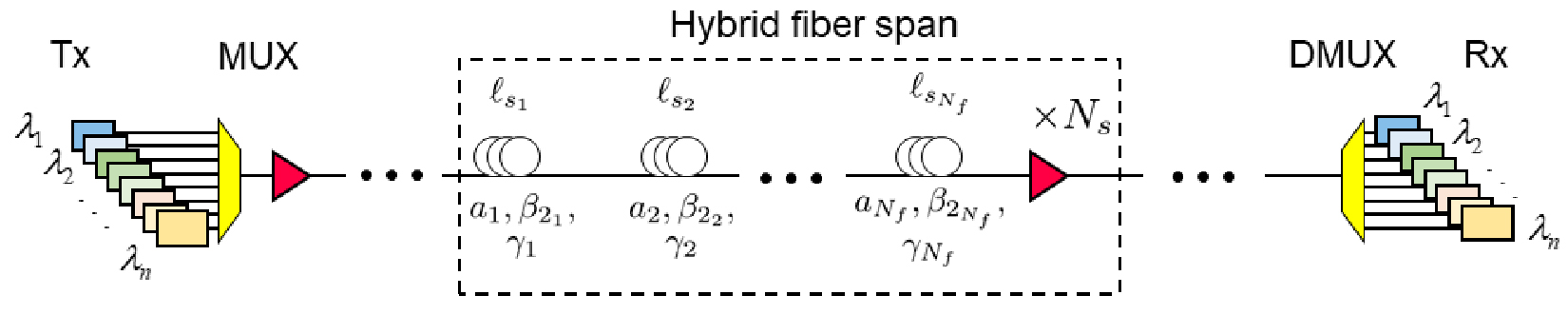
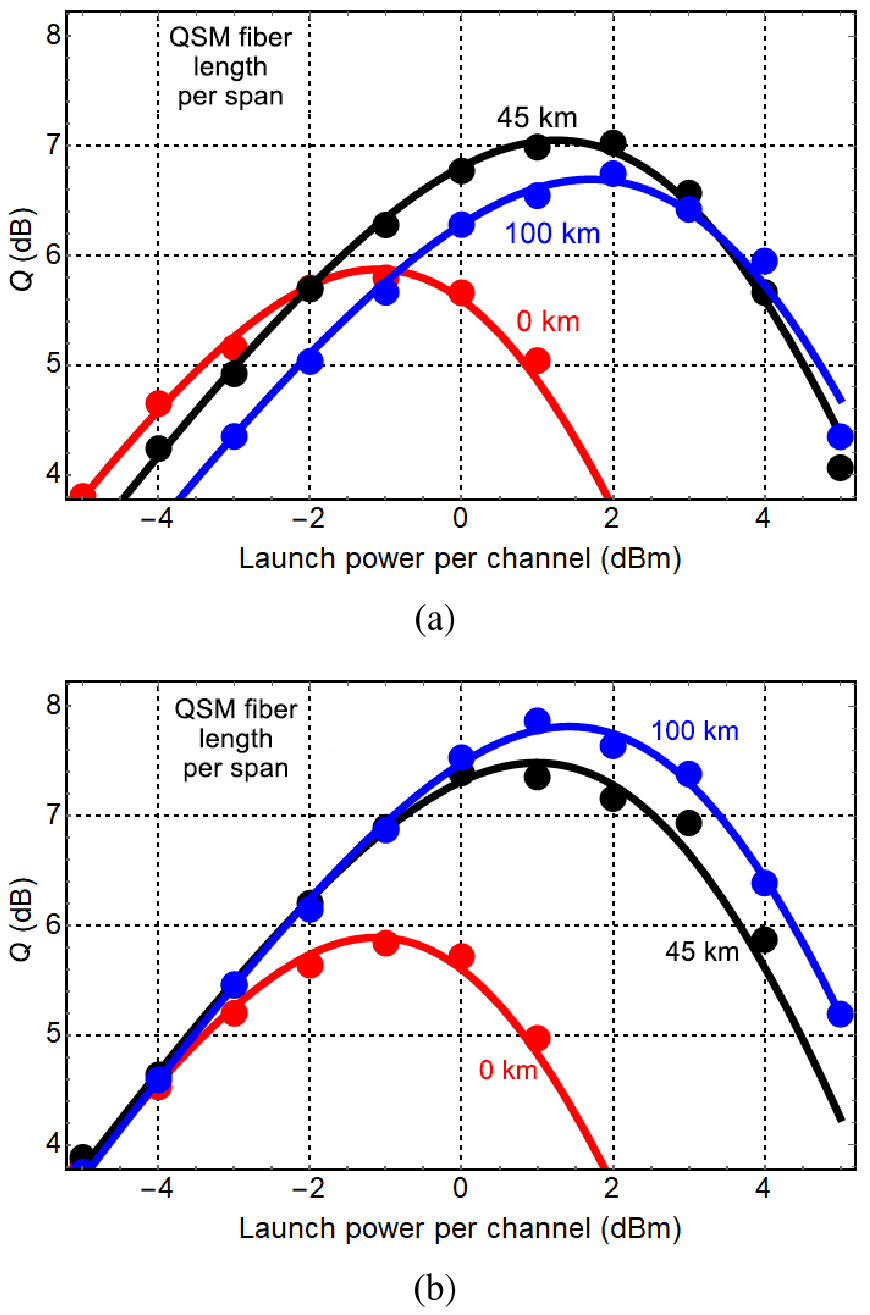
Abstract We rederive from first principles and generalize the theoretical framework of the nonlinear Gaussian noise model to the case of coherent optical systems with multiple fiber types per span and ideal Nyquist spectra. We focus on the accurate numerical evaluation of the integral for the nonlinear noise variance for hybrid fiber spans. This task consists in addressing four computational aspects: (1) Adopting a novel transformation of variables (other than using hyperbolic coordinates) that changes the integrand to a more appropriate form for numerical quadrature; (2) Evaluating analytically the integral at its lower limit, where the integrand presents a singularity; (3) Dividing the interval of integration into subintervals of size and approximating the integral over each subinterval by using various algorithms; and (4) Deriving an upper bound for the relative error when the interval of integration is truncated in order to accelerate computation. We apply the proposed analytical model to the performance evaluation of coherent optical communications systems with hybrid fiber spans composed of quasi-single-mode and single-mode fiber segments. More specifically, the model is used to optimize the lengths of the optical fiber segments that compose each span in order to maximize the system performance. We check the validity of the optimal fiber segment lengths per span provided by the analytical model by using Monte Carlo simulation, where the Manakov equation is solved numerically using the split-step Fourier method. We show that the analytical model predicts the lengths of the optical fiber segments per span with satisfactory accuracy so that the system performance, in terms of the Q-factor, is within 0.1 dB from the maximum given by Monte Carlo simulation.
|
|
Received: 23 October 2020
Online: 19 August 2021
|
|
Corresponding Authors:
Ioannis Roudas
E-mail: ioannis.roudas@montana.edu;jarek@math.montana.edu;jessica.jiang@csi.cuny.edu
|
| About author: Ioannis Roudas received the BS degree in physics and the MS degree in electronics and radio-engineering from the University of Athens, Greece in 1988 and 1990, respectively, and the MS and PhD degrees in coherent optical communication systems from the Ecole Nationale Supérieure des Télécommunications (currently Télécom ParisTech), Paris, France in 1991 and 1995, respectively. During 1995-1998, he worked in the Optical Networking Research Department, Bell Communications Research (Bellcore), Red Bank, NJ. At the same time, he taught for two semesters, as an adjunct professor, at Columbia University. He was subsequently with the Photonic Modeling and Process Engineering Department, Corning Inc., Somerset, NJ, from 1999 to 2002. He spent an eight-year period in Greece, during 2003-2011, working at the Department of Electrical and Computer Engineering, University of Patras as an associate professor of optical communications. In addition, he taught, as an adjunct professor, at the City University of New York and the Hellenic Open University. During 2011-2016, he was a research associate with the Science and Technology Division of Corning Inc., Corning, NY. Since July 2016, he has been with the Department of Electrical and Computer Engineering, Montana State University as the Gilhousen Telecommunications chair professor. He is the author or co-author of more than 100 papers in scientific journals and international conferences and holds five patents. He served as an associate editor for the IEEE Photonics Journal during 2013-2019. His current research focuses on optical communications systems with multimode and multicore fibers and on quantum networking.|Jaroslaw Kwapisz is a Polish-American mathematician with background in theoretical dynamical systems. He received the MS (1991) degree from University of Warsaw and the PhD degree (1995) from State University of New York at Stony Brook. Since July 2008, he has been a professor of mathematics at the Department of Mathematical Sciences, Montana State University. He has worked on problems in several subject areas, including integral and differential equations, iterated maps modeling coupled non-linear oscillators, pattern formation in fourth-order Hamiltonian systems, ergodic theory and entropy in smooth and symbolic dynamics, cohomological Conley index and cocyclic subshifts, almost-periodic tiling spaces and quasi-crystals, abelian-Nielsen classes and geometry of translation surfaces, and conformal dimension of fractal sets. He is currently interested in Anosov maps on infra-nil manifolds, non-Meyer substitution Delone sets, and problems in classical and quantum multi-mode fiber-optic communication.|Xin Jiang received the BS, MS, and PhD degrees in electronic engineering from Tsinghua University, Beijing, China, the former one in 1990, and the later two in 1995. She is currently an associate professor at the Department of Engineering and Environmental Science, College of Staten Island (CSI), City University of New York, NY, USA. Prior joining CSI, she has worked in R&D and engineering departments of several high-tech and telecommunication companies. She has authored and co-authored over 60 publications in peer-reviewed journals and international conferences. Her current areas of research include advanced optical fiber transmission technology and photonic systems and networks. |
|
|
| [1] |
Agrawal G. P., Nonlinear Fiber Optics, 5th ed. Academic Press, 2012.
|
| [2] |
Wai P. K. A. and Menyuk C. R., Polarization mode dispersion, decorrelation, and diffusion in optical fibers with randomly varying birefringence, J. Lighttw. Technol., vol. 14, no. 2, pp. 148-157, 1996.
|
| [3] |
Chen X. and Shieh W., Closed-form expressions for nonlinear transmission performance of densely spaced coherent optical OFDM systems, Opt. Express, vol. 18, no. 18, pp. 19 039-19 054, 2010.
|
| [4] |
Shieh W. and Chen X., Information spectral efficiency and launch power density limits due to fiber nonlinearity for coherent optical ofdm systems, IEEE Photonics Journal, vol. 3, no. 2, pp. 158-173, 2011.
|
| [5] |
Poggiolini P., Carena A., Curri V., Bosco G., and Forghieri F., Analytical modeling of nonlinear propagation in uncompensated optical transmission links, IEEE Photon. Technol. Lett., vol. 23, no. 11, pp. 742-744, 2011.
|
| [6] |
Carena A., Curri V., Bosco G., Poggiolini P., and Forghieri F., Modeling of the impact of nonlinear propagation effects in uncompensated optical coherent transmission links, J. Lighttw. Technol. vol. 30, no. 10, pp. 1524-1539, 2012.
|
| [7] |
Poggiolini P., The GN model of non-linear propagation in uncompensated coherent optical systems, J. Lightwave Technol., vol. 30, no. 24, pp. 3857-3879, 2012.
|
| [8] |
Johannisson P. and Karlsson M., Perturbation analysis of nonlinear propagation in a strongly dispersive optical communication system, J. Lighttw. Technol., vol. 31, no. 8, pp. 1273-1282, 2013.
|
| [9] |
Poggiolini P., Bosco G., Carena A., Curri V., Jiang Y., and Forghieri F., The GN-model of fiber non-linear propagation and its applications, J. Lightwave Technol., vol. 32, no. 4, pp. 694-721, 2014.
|
| [10] |
Mecozzi A. and Essiambre R. J., Nonlinear Shannon limit in pseudolinear coherent systems, J. Lighttw. Technol., vol. 30, no. 12, pp. 2011-2024, 2012.
|
| [11] |
Dar R., Feder M., Mecozzi A., and Shtaif M., Properties of nonlinear noise in long, dispersion-uncompensated fiber links, Opt. Express, vol. 21, no. 22, pp. 25 685-25 699, 2013.
|
| [12] |
Carena A., Bosco G., Curri V., Jiang Y., Poggiolini P., and Forghieri F., EGN model of non-linear fiber propagation, Opt. Express, vol. 22, no. 13, pp. 16 335-16 362, 2014.
|
| [13] |
Serena P. and Bononi A., A time-domain extended Gaussian noise model, J. Lighttw. Technol., vol. 33, no. 7, pp. 1459-1472, 2015.
|
| [14] |
Ghazisaeidi A., A theory of nonlinear interactions between signal and amplified spontaneous emission noise in coherent wavelength division multiplexed systems, J. Lightwave Technol., vol. 35, no. 23, pp. 5150-5175, 2017.
|
| [15] |
Curri V., Carena A., Poggiolini P., Bosco G., and Forghieri F., Extension and validation of the GN model for non-linear interference to uncompensated links using Raman amplification, Opt. Express, vol. 21, no. 3, pp. 3308-3317, 2013.
|
| [16] |
Poggiolini P. and Jiang Y., Recent advances in the modeling of the impact of nonlinear fiber propagation effects on uncompensated coherent transmission systems, J. Lightwave Technol., vol. 35, no. 3, pp. 458-480, 2017.
|
| [17] |
Semrau D., Killey R. I., and Bayvel P., The Gaussian noise model in the presence of inter-channel stimulated Raman scattering, J. Lighttw. Technol., vol. 36, no. 14, pp. 3046-3055, 2018.
|
| [18] |
Rabbani H., Liga G., Oliari V., Beygi L., Agrell E., Karlsson M., and Alvarado A., A general analytical model of nonlinear fiber propagation in the presence of Kerr nonlinearity and stimulated Raman scattering, arXiv preprint arXiv:1909.08714, 2019.
|
| [19] |
Poggiolini P., A closed-form GN-model non-linear interference coherenceterm, arXiv preprint arXiv:1906. 03883, 2019.
|
| [20] |
Ranjbar Zefreh M. and Poggiolini P., A GN-model closed-form formula considering coherency terms in the link function and covering all possible islands in 2-D GN integration, arXiv preprint arXiv:1907.09457, 2019.
|
| [21] |
Ranjbar Zefreh M. and Poggiolini P., A closed-form approximate incoherent GN-model supporting MCI contributions, arXiv preprint arXiv:1911.03321, 2019.
|
| [22] |
Downie J. D., Mlejnek M., Roudas I., Wood W. A., Zakharian A., Hurley J. E., Mishra S., Yaman F., Zhang S., Ip E., and Huang Y. K., Quasi-single-mode fiber transmission for optical communications, IEEE J. Sel. Top. Quantum Electron., vol. 23, no. 3, pp. 1-12, 2017.
|
| [23] |
Miranda L., Roudas I., Downie J. D., and Mlejnek M., Performance of coherent optical communication systems with hybrid fiber spans, in Proc. of Eur. Conf. Opt. Commun. (ECOC), Gothenburg, Sweden, 2017, p. P2.SC6.18.
|
| [24] |
Al-Khateeb M. A. Z., Iqbal M. A., Tan M., Ali A., McCarthy M., Harper P., and Ellis A. D., Analysis of the nonlinear Kerr effects in optical transmission systems that deploy optical phase conjugation, Opt. Express, vol. 26, no. 3, pp. 3145-3160, 2018.
|
| [25] |
Krzczanowicz L., Al-Khateeb M. A. Z., Iqbal M. A., Phillips I., Harper P., and Forysiak W., Performance estimation of discrete Raman amplification within broadband optical networks, in Proc. of Opt. Fiber Commun. Conf. (OFC), 2019, San Diego, CA, USA, 2019, p. Tu3F.4.
|
| [26] |
Bononi A., Beucher O., and Serena P., Single- and cross-channel nonlinear interference in the gaussian noise model with rectangular spectra, Opt. Express, vol. 21, no. 26, pp. 32 254-32 268, 2013.
|
| [27] |
Mlejnek M., Roudas I., Downie J. D., Kaliteevskiy N., and Koreshkov K., Coupled-mode theory of multipath interference in quasi-single mode fibers, IEEE Photon. J., vol. 7, no. 1, pp. 1-16, 2015.
|
| [28] |
Nayfeh A. H., Perturbation Methods. Wiley, 2008.
|
| [29] |
Bender C. M. and Orszag S. A., Advanced mathematical methods for scientists and engineers I: Asymptotic methods and perturbation theory. Springer, 2013.
|
| [30] |
Proakis J. and Salehi M., Digital Communications, 5th ed. McGraw-Hill, 2007.
|
| [31] |
Forestieri E. and Secondini M., Solving the nonlinear Schr?dinger equation, in Optical Communication Theory and Techniques, Forestieri E., ed. Springer, 2005, pp. 3-11.
|
| [32] |
Rudin W., Real and Complex Analysis, 3rd Ed. McGraw-Hill, 1987.
|
| [33] |
Agrawal G. P., Fiber-Optic Communication Systems, 4th ed. Wiley, 2010.
|
| [34] |
Olver S., Numerical approximation of highly oscillatory integrals, PhD dissertation, University of Cambridge, Cambridge, UK, 2008.
|
| [35] |
Anton H. and Herr A., Calculus with Analytic Geometry. Wiley, 1995.
|
| [36] |
Wolfram Research Inc., Mathematica 12.0, , 2019.
|
| [37] |
Fejér kernel-Wikipedia, the free encyclopedia, , 2018.
|
| [38] |
Downie J. D., Li M. J., Mlejnek M., Roudas I. G., Wood W. A., and Zakharian A. R., Optical transmission systems and methods using a QSM large-effective-area optical fiber, US Patent 9 841 555, Dec. 12, 2017.
|
| [39] |
Li M. J., Mishra S. K., Mlejnek M., Wood W. A., and Zakharian A. R., Quasi-single-mode optical fiber with a large effective area, U.S. Patent 9 846 275, Dec. 19, 2017.
|
| [40] |
Sui Q., Zhang H., Downie J. D., Wood W. A., Hurley J., Mishra S., Lau A. P. T., Lu C., Tam H. Y., and Wai P. K. A., Long-haul quasi-single-mode transmissions using few-mode fiber in presence of multi-path interference, Opt. Express, vol. 23, no. 3, pp. 3156-3169, 2015.
|
|
Viewed |
|
|
|
Full text
|
|
|
|
|
Abstract
|
|
|
|
|
Cited |
|
|
|
|
| |
Shared |
|
|
|
|
| |
Discussed |
|
|
|
|